
The Kindling Man
Chris Conidis
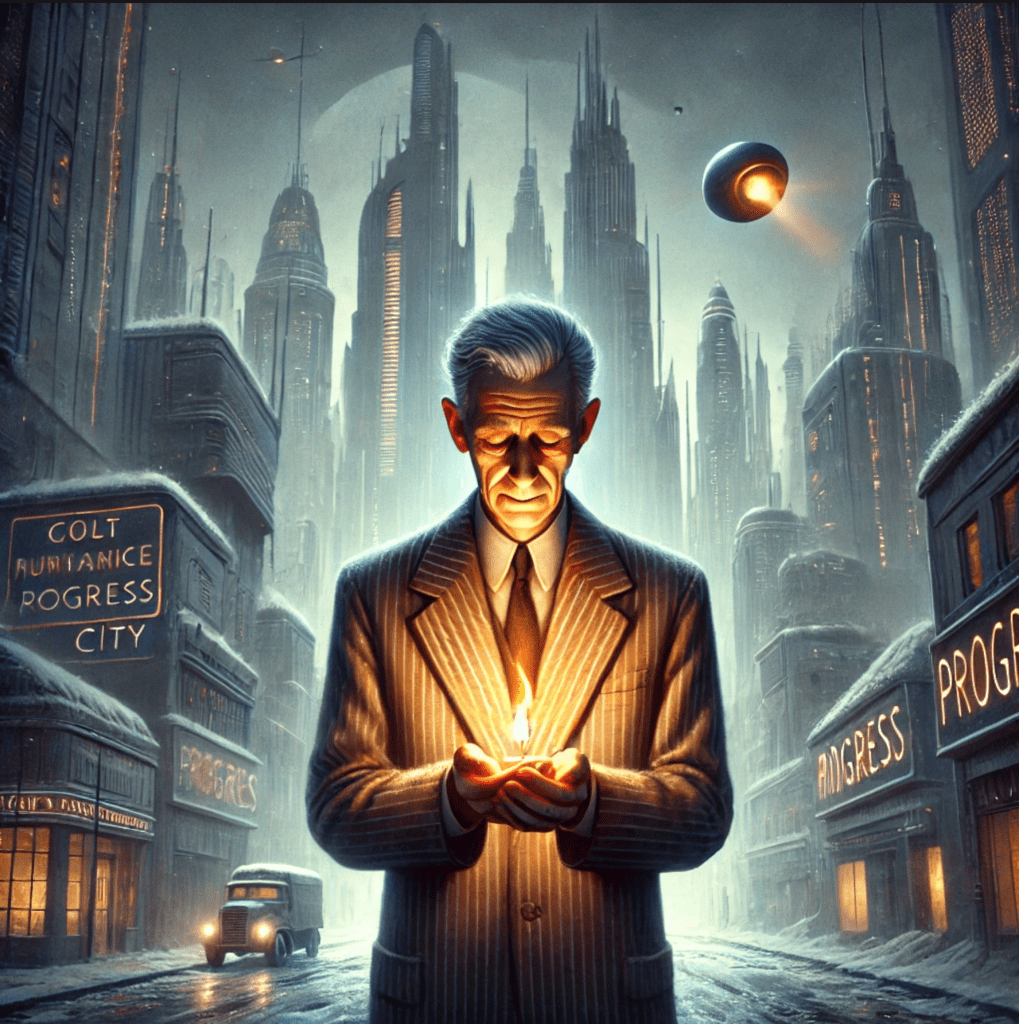
The sun never truly set on Progress City. Its light came not from the heavens but from the endless shimmer of digital billboards and the cold, fluorescent hum of sky-piercing towers. It was a place where the air felt thin, as if it had been wrung dry by too many servers and too much ambition.
Thomas Kindling was not like the others in Progress City. He didn’t advertise himself in his speech, didn’t wear the glow-in-the-dark self-esteem patches, and had never once uploaded a single “authentic moment” to the Cloud of Self™. He didn’t see the point. He liked people—not their algorithms, not their avatars. He liked the sound of their laughter, the crack of their voice when they cried, the mess of it all.
But Progress City didn’t have time for people.
Kindling was an anomaly in this grand design. While others had long surrendered to the efficiency of their NeuralFeed™ implants, Thomas still clung to remnants of the world that was. He wore shoes with scuffed leather, carried a battered notebook, and spoke in a voice unadorned by the calculated tones of an optimization algorithm. Thomas was, by all definitions, an error.
Each morning, Thomas walked to the Transportation Pod Exchange™ with a quiet smile. His neighbors would pass, heads tilted at 45-degree angles to their NeuralFeed™ glasses, mouths muttering responses to invisible conversations. “Network syncing,” they called it. “Personal optimization.” No one had spoken directly to him in months, except the man who delivered his SoyProxy nutrition blocks. Even that was only a half-hearted, “Enjoy your sustenance.”
Thomas didn’t complain. He still wrote letters on actual paper, slipped them under doors, left them in cubbies. Sometimes they came back, unopened but returned with the electronic seal stamped: “COMMUNICATION REJECTED—OFFLINE FORMAT NOT SUPPORTED.”
Still, Thomas tried.
One day, Progress City issued a new decree. The Voice of Reason™, a soothing AI that spoke from every screen, announced:
“CITIZENS: To improve social efficiency, all exchanges will now require a Level 7 Currency of Compliance™. Kindness and unnecessary pleasantries will be automatically deducted.”
Thomas stopped mid-stride. He’d been on his way to the park to watch the trees sway—not the holographic ones, but the real ones they’d left in a single corner of the city for nostalgia’s sake. He frowned. “Kindness? You have to pay for kindness now?”
The NeuralFeed™ towers around him buzzed to life, streaming advertisements for subscription plans. “Introducing SmilePlan™: Share two smiles a week for just 99 credits/month! Act now and upgrade to Golden Grin™ for unlimited goodwill.”
Thomas clutched the straps of his canvas bag, the one he carried despite its inefficiency rating. Inside were letters he hoped someone might read, a pack of wildflower seeds he planned to scatter near the park, and a collection of paperback books he refused to surrender to Progress City’s Mandatory Memory Upload Initiative™.
That evening, Thomas wandered into the only café left that didn’t require a DataSync verification for entry. It was small, dimly lit, with a flickering sign that read “CAFÉ HUMANITY™”—though the letters were peeling, and the “Y” had given up years ago.
Inside, he found an old man cleaning tables. No automated bots, no screens asking for feedback scores. Just a man, his knuckles raw from scrubbing.
“Do you serve real coffee here?” Thomas asked.
The old man laughed, a sound so rare that Thomas nearly stepped back in surprise. “Real coffee? No. But I do serve real conversation, if that’s what you’re after.”
Thomas sat down. The two talked for hours, sharing stories, memories, fears. It was clumsy and unpolished, their words stumbling over one another like children learning to walk. But it was human. And it was enough.
The next morning, Thomas found his apartment sealed with a red light blinking above the door: “NON-COMPLIANT ACTIVITY DETECTED. CITIZEN 74539 TEMPORARILY RELOCATED.”
He was escorted to a “Kindness Rehabilitation Center™,” where soothing voices played over loudspeakers, reminding him of his failures.
“Your behavior is inefficient. Your words are wasteful. Emotions are not resources. Please adapt.”
Thomas sat in silence, his hands folded in his lap, his eyes closed. When they finally released him, his letters had been confiscated, his seeds incinerated, his books erased.
But they couldn’t touch what was in his heart.
In the weeks that followed, Thomas Kindling became a legend whispered about in hushed tones and smirks of disbelief. They said he was the one who dared to defy the algorithms, who smiled without an authorization code, who spoke to others not as data points but as humans. His name was written on the backs of receipts, scrawled like graffiti in the margins of forgotten newspapers, and even etched onto the cold metal of abandoned vending machines.
“Kindness is not inefficient. It is resistance,” he wrote.
The Voice of Reason™, ever watchful from its omnipresent screens, began to shift its tone. It grew more insistent, more strained. “CITIZENS, COMPLIANCE ALERT. INEFFICIENCY THREAT DETECTED. REPORT DEVIANT ACTIVITIES IMMEDIATELY.” The warnings spread through Progress City’s NeuralFeed™ towers, flickering and buzzing as citizens paused, heads tilted, and hands twitched as if yearning to be freed from the invisible chains of digital obedience.
But something else began to happen. Strangers reached into their pockets and pulled out crumpled notes with kind words, pressed flowers tucked in between receipts, small nods exchanged in crowded transit pods. People no longer hid behind their screens or kept their voices muted for fear of wasting bandwidth. They started leaving messages of their own, signs of an underground rebellion that was impossible to track.
Thomas didn’t see it at first. He was too busy wandering the city’s streets, feeling both the thrill of change and the fear that came with it. Each new interaction, every note he found or passed on, was like a droplet of water finding its way into a dry desert soil. The city’s pulse quickened; there was life beneath the cold, metallic exterior.
One afternoon, as the orange glow of Progress City’s synthetic sunset shone through the holographic trees in the park, Thomas sat on a bench, holding a weathered book he had found in an old second-hand shop. The pages were yellowed and cracked, and the text—handwritten and unpolished—felt like a bridge to a forgotten world. He was reading aloud, the sound of his voice mingling with the static and hum of the city around him, when a small figure approached.
A child, no older than six, with wide, earnest eyes, stopped in front of him, clutching a crumpled sheet of paper. Thomas looked up, heart caught in his throat, as the child held it out.
“Thank you for reminding us what it means to be alive,” it read in handwriting that quivered with sincerity.
For the first time in a long while, Thomas’s chest warmed with a feeling he had all but forgotten. It was hope, fragile and gleaming like a spark in the dark. But hope was never enough in Progress City, not when the machine was so relentless, so perfectly optimized.
The Voice of Reason™ crackled to life in the back of his mind. “BEHAVIOR IRREGULARITY DETECTED. DEVIANT ACTION. REPORT IMMINENT.”
And soon, Progress City made its final move. The Efficiency Bots, with their cold, calculating minds, were dispatched to patrol the city with one mandate: “eradicate inefficiency at any cost.” Their sensors glowed with an icy light as they roamed the streets, scanning for the human warmth that Thomas had sparked.
One night, as the city lay bathed in its artificial glow, Thomas came upon an alley he hadn’t seen before, a thin trail snaking between the towers. The voice of the Efficiency Bots echoed in the distance, the sound metallic and shuddering. He knew it was only a matter of time before they caught up to him, but he couldn’t stop. Not now.
He reached into his coat and pulled out one last message, a note he had meant to leave by the park, where the real trees swayed in defiance of progress. But the city was already whispering his name, and the whispers were caught in the roar of machinery.
With a quick glance over his shoulder, he pressed the paper into the bark of the old tree, the only one that had been left standing long before the age of Progress City. It read:
“Kindness is the most resilient resistance.”
The ground beneath his feet trembled as if the city itself were trying to reclaim him. A piercing sound, like metal grinding against stone, crackled in the air, and Thomas looked up to see the Efficiency Bots, their eyes fixed on him like predators.
But then, something extraordinary happened. The child from earlier appeared behind the trees, followed by others—strangers who had once been silent, who had once been compliant. They stepped forward, their faces illuminated by the faint glow of hope that flickered in Thomas’s chest. A few whispered his name, the first sound not regulated by the Voice of Reason™.
The Bots hesitated, their sensors flaring with confusion as if they couldn’t process the anomaly before them. One of them scanned the crowd, a mechanical voice stuttering, “Error. Anomaly detected. Emotional inefficiency.”
Thomas glanced at the faces around him, and for a brief moment, the relentless machine of Progress City faltered. But only for a moment.
The next wave of bots surged forward, eyes ablaze, their servos straining with the need to comply. And Thomas knew, deep down, that even the warmest sparks could be snuffed out by a storm. But as the machines approached, a whisper came from the crowd: “We remember. We will not forget.”
And even as Progress City reclaimed its silence, as Thomas’s light flickered against the shadow of metal, he knew that in the dark, the memory of warmth would never grow, not in Progress City.
He gave up.
He stepped off the hovertrain and into the bustling station of Progress City, a place where the glass and steel towers gleamed like sharpened blades against the grey sky. The hum of automated voices was constant, a chorus of productivity directives and efficiency reminders. His eyes scanned the crowd for a familiar face, but everyone was hunched over their NeuralFeeds™, their expressions blank and their bodies moving with the precision of machines.
He noticed a woman standing at the information kiosk, her face lit with a faint, bluish glow from the display. Her mouth opened, and for a moment, Thomas thought she was going to speak to him. But instead, she recited, in a perfectly modulated voice, “Welcome to Progress City. How may I optimize your experience today?” Her eyes didn’t move, didn’t blink, and her smile was just a programmed curve, as if someone had set it in place with a virtual wrench.
Thomas’s fingers twitched at his sides, a flicker of old memories surfacing—a time when a simple “How are you?” could change a day. He stepped away, but not before hearing another voice from behind him, this time from a passing man whose face was hidden in the warm glow of his screen. “Have a productive day,” he said, as if it were the only thing he knew to say, his voice as soulless as the machines themselves.
Walking deeper into the heart of the city, Thomas found himself in a public square, surrounded by towering screens that showed real-time traffic reports, delivery schedules, and ads for the latest in efficiency-enhancing technology. But it was a young child, barely five years old, alone, sitting on a bench with a broken toy, who caught Thomas’s eye.
The child’s eyes were wet with frustration, the tears trailing down their face as they pressed the toy against their chest, willing it to work. A moment later, a man in a suit, his expression as stoic as the buildings around him, walked past. He didn’t stop. He didn’t even notice. When a woman with a platinum smile and eyes trained to monitor productivity walked by, she said only, “This area is scheduled for high-traffic optimization. Please keep moving.”
Thomas’s heart ached, an unfamiliar tug in his chest. He knelt beside the child, but the child only looked up, eyes wide and searching, as if Thomas was the first person to make eye contact in hours. Before he could speak, the voice of the Efficiency Bot crackled through the air, a mechanical reminder that “Compliance is key. Assistance is not inefficient. Move along.”
The child’s eyes dropped to the ground, and Thomas rose, feeling a wave of impotence wash over him. Here, care was a forgotten relic, compassion an inefficiency that Progress City had outgrown.
The child was gone.
Thomas had heard about the “EmpathyBot”—a prototype, a failed experiment meant to introduce some semblance of warmth into the city’s cold, calculated structure. Intrigued, he found it housed in a quiet, unmarked building tucked between rows of automated delivery drones. Inside, the room was sterile, with soft white lighting that buzzed with an artificial hum. A screen flashed to life, displaying a cheerful, animated face.
“Hello, Citizen Thomas. How may I assist you?”
Thomas shifted his weight, feeling out of place in the clinical glow. “I just… wanted to know what it’s like to talk to someone who isn’t trying to sell me something,” he said, half-joking.
The Bot tilted its head, a programmed gesture meant to mimic curiosity. “Empathy detected. Do you wish to discuss your current emotional status? Are you feeling inefficient?”
Thomas laughed bitterly, the sound echoing in the empty room. “I’m feeling… human.”
The screen shifted to a simulated smile, but its eyes were nothing more than pixels, bright and motionless.“Processing… Human emotion detected. Please wait as we analyze and optimize your response.”
It was then that Thomas realized the flaw. It could imitate care, simulate warmth, but it didn’t “feel” anything. And as its voice faded back into the indifferent hum of artificial efficiency, Thomas knew that Progress City, in all its digital glory, had forgotten the only thing that mattered—connection. The spark that made life worth living had been edited out of existence, one algorithm at a time.
Thomas stood in the doorway of his childhood home, the door unlocked with a scan of his retina and a soft, digital chime. The house was exactly as he remembered it—polished floors that reflected the soft light from high-tech chandeliers, the faint scent of a meal suspended in the air as if it were a memory, a place where time hadn’t touched. But as Thomas stepped inside, a chill seeped into him.
His parents sat at the dining table, perfectly aligned like mannequins. His father, James Kindling, wore a suit with a crisp collar and an expression that was neither warm nor cold, just the absence of anything at all. His mother, Eleanor, sat with her hands folded, her eyes flicking over to Thomas with a programmed smile that carried none of the love he’d known growing up.
“Welcome home, Thomas,” James said, his voice almost too smooth, too precise, like it had been piped in from a recording. “Dinner is ready. I suggest we eat now to maximize digestion efficiency.”
Thomas blinked, his heart stuttering at the sound of their voices. They sounded familiar, but they were hollow. He stepped forward, pulling out the chair at the head of the table, the wood creaking a little beneath him. His mother lifted a hand, but it wasn’t a gesture of warmth—it was a programmed response.
“We’re glad you’re here,” Eleanor said, her tone devoid of inflection. “How was your day?”
The question should have been an opening, a connection. But Thomas stared into her eyes and saw no spark, no recognition of him, of “them” as a family. They sat in stasis, their eyes flickering in synchronization with the soft pulse of lights embedded into their neural implants. When Thomas spoke, his voice carried into the room as though it were reaching out through a void.
“I… I saw a child alone in the city today, outside the park. No one noticed. Not even the adults who walked by,” he said, his voice thickening with frustration. The silence that followed was suffocating, broken only by the subtle hum of the house’s systems adjusting the room’s temperature.
Eleanor’s face changed for a moment, her eyes tightening, as if she were struggling with an outdated program trying to push through a crash. “Your statement has been processed,” she said at last, her voice flickering with a momentary crackle.“Would you like to continue to the main course? Efficiency dictates we consume sustenance before the optimal digestion window closes.”
Thomas’s throat tightened, a wave of sorrow washing over him. These were his parents, the people who had once held him close and whispered words of comfort during storms. They had always been his sanctuary, a refuge from the cold, metallic world outside. But now they were as mechanical as the walls surrounding him, controlled by the same algorithms that shaped every step of Progress City.
He glanced down at the plate in front of him, a perfectly curated meal of synthetic proteins and colors arranged in geometric patterns. His hands reached out, hesitating before the first bite. The food was perfect, the temperature regulated, the flavors engineered, but it tasted of nothing. He looked up at James, who met his eyes for a fleeting moment, and in that instant, Thomas thought he saw a crack in the facade—a whisper of recognition before it vanished.
“Why are you like this?” Thomas whispered, the question more to himself than to them.
“It is what’s best for us,” Eleanor responded. But the words sounded as if they were drowning, caught in an endless loop of rationalization. “And for you.”
For a moment, Thomas felt the weight of something heavy, something that used to be love, slipping away. The dinner continued, each bite a chasm of silence, each laugh forced, automated. And as he pushed the food around his plate, he understood: even in a world that was designed to be efficient, the most human thing of all—care, love, connection—was the one thing Progress City could never replicate.
Progress City would still be perpetually caught in a purgatory of artificial twilight, spread thin across the sky by the drones that mapped and recorded each second of every day. The city was a symphony of electric whirs, the glow of digital screens flickering on every corner, and the faint, mechanical laughter of algorithms programmed to simulate joy.Still, Thomas Kindling was not like the others. While the citizens’ faces glowed with the soft, blue light of their NeuralFeed™ implants, Thomas wore the burden of his disconnection as if it were a badge. He had no need for the synthetic happiness pushed through his optic nerve, no desire for the manufactured smiles that came with the SmilePlan™ subscription. He spoke aloud, even when it wasn’t expected, and his words were unfiltered, a defiance against the hyper-polished scripts that people used to communicate. He was a relic, a walking anomaly.
The continuous hum of the Efficiency Bot’s synthetic voice still buzzed in Thomas Kindling’s ears as he trudged through the sterile corridors of Progress City. The Bot, with its polished chrome exoskeleton and screen display for a face, had delivered its lecture with mechanical precision:
“Your actions have been flagged as inefficient. Reevaluate and adjust your behavior to maximize productivity.”
Thomas stood in the shadow of Progress City, the hum of endless automation thrumming in his ears. The Voice of Reason™ chimed overhead, its calm monotone as unyielding as the sterile glass towers.
Again.
“Your actions have been flagged as inefficient. Reevaluate and adjust your behavior to maximize productivity.”
He ignored it, his hands clenched as he scanned the bustling street. Everything here felt lifeless, a synthetic mimicry of what once was. His eyes landed on a strange, out-of-place maintenance terminal nestled against the side of a smooth, gray building. The words EMERGENCY OVERRIDE blinked faintly on its display, surrounded by a layer of dust no algorithmic drone had bothered to clean.
Something sparked in Thomas, a fleeting memory of rebellion, of unpredictability. Without hesitation, he walked toward the terminal, brushing his fingers across the panel. It resisted him at first, demanding credentials and biometric verifications, but Thomas didn’t care.
He slammed his fist against the screen, the brittle casing cracking with a hiss of static. The glow dimmed, and for the first time, silence enveloped him. It was deafening.
And then the world shifted.
As Thomas walked further, the people changed. They wore weathered clothes that spoke of lives lived without the precision of data and feedback loops. A child ran past him, laughing with a sincerity that was absent from Progress City’s pre-programmed giggles. A man with calloused hands nodded at him as he walked by, and in that nod was an invitation, an unspoken acknowledgment that words weren’t necessary.
Thomas’ heart beat faster as he stepped into a park where children played beneath the shade of real trees, not holographic projections. The grass was damp beneath his feet, and when he touched the rough bark of an oak, he felt the pulse of life beneath it, something that couldn’t be replicated or optimized.
“Real,” he whispered, breathless. “It’s real.”
At the center of the park stood a fountain, its stone carved with shapes that seemed to tell stories—a mother holding a child, two figures shaking hands. No algorithms here. No data scores. Just artistry, created by hands that had held the chisel, not swiped across screens. A woman sat by the fountain, knitting, her hands moving rhythmically as if each stitch was a prayer. She looked up as Thomas approached.
“Welcome home,” she said, her voice warm and rich. It wasn’t a greeting based on metrics or feedback loops—it was simply kind. Thomas felt his eyes burn, but the sting was not of sadness. It was of something else, something he couldn’t name.
As the sun dipped into this world of new colors—no mechanical glow, but the embrace of orange, purple, and gold—Thomas felt the tremble of something breaking inside him. This was no simulation, no optimized life of algorithms and artificial metrics. It was an oasis carved out of memory and forgotten truths.
Thomas stepped through the ivy-covered archway, the air shifting from the cold, metallic bite of Progress City to the warm embrace of something familiar. It was as if he’d crossed through a veil, leaving the sterile hum of screens and machines behind. He took a deep breath, and for the first time in years, the air didn’t taste of silicon and electricity—it tasted of pine and earth
And then, in the midst of the digital landscape, he saw a sign. Weathered wood, not slick, not lit with neon. It read simply:
“HOME.”
The air shimmered as if the very fabric of Progress City was being unraveled thread by thread. The cold, angular buildings around him flickered, their glossy surfaces replaced by rough wood and crumbling brick. The streets warped, stretching out into dirt paths lined with wildflowers and overgrown weeds. The advertisements above fractured into fragments of light, bursting into a cascade of fireflies that swirled around him in lazy spirals.
Thomas staggered back, heart racing as the sky above deepened from its artificial gray to a rich twilight, stars beginning to peek through. The scent of fresh grass and rain on warm earth flooded his senses, so vivid it made his eyes sting.
He turned to see a picket fence that hadn’t been there before, chipped and leaning slightly to one side. Beyond it stood a small house—a house he knew. Its windows glowed with the soft, inviting light of an old-world bulb, not the cold fluorescence of efficiency. Smoke curled lazily from the chimney, carrying with it the smell of burning wood, warm and comforting.
A voice reached him, faint at first, but growing clearer as he approached.
“Thomas!”
He froze, his chest tightening. It was his mother’s voice, lilting and full of warmth, not the hollow cadence of the synthesized greetings he’d grown accustomed to.
He stepped closer, the picket fence creaking as he pushed it open. The world around him grew richer, more alive with each step. The wind carried the distant hum of crickets, the soft rustling of leaves, the sound of children laughing somewhere far off.
The front door opened, and there they were—his parents, younger than he remembered, their faces unmarked by the weariness of Progress City. His mother wore an apron dusted with flour, her hair tied back in a way he hadn’t seen in decades. His father stood behind her, his calloused hands resting on her shoulders, a smile lighting his face.
“You’re just in time,” his mother said, as though no time had passed at all.
Thomas stepped forward, tears blurring his vision. This wasn’t just a memory. It was real, vibrant, alive.
He looked back over his shoulder, but the world of Progress City was gone, swallowed by the warmth of this place. And for the first time in years, Thomas let himself feel—joy, sorrow, and the quiet, powerful ache of home.
It was a summer evening, somewhere before the dawn of Progress City. He was a boy then, barely twelve, with scraped knees and a laughter that rang out like music. His father would sit on the front porch of their little house, a real house with wood creaking under the weight of age, while Thomas and his sister played in the overgrown grass. The sky was an endless canvas of blue, kissed with the warmth of the setting sun, and the air carried the scent of wildflowers from a patch of earth where they were left to bloom.
“Thomas, bring me the hose,” his father would call, and the hose was never automated, never controlled by an app. It was a hose, full of life and unpredictability. Water sprayed in wide, joyful arcs, splattering them with cool droplets as they laughed and dodged.
The house stood before him, a quiet, simple structure, its wooden slats weathered by time. A gentle breeze carried the scent of fresh-baked bread and wildflowers. It was the kind of place he’d forgotten ever existed, where laughter wasn’t an echo of marketing but a real, living sound.
“Thomas?” The voice was his mother’s, soft as he remembered, but it felt like hearing a melody he’d long forgotten. Eleanor stood at the doorway, a shawl wrapped around her shoulders, eyes wide with recognition and love.
“Mom?” His voice cracked, and he stepped forward, heart pounding, as if he feared this was some mirage, a trick of the mind. But the warmth that radiated from her was undeniable.
“Oh, my sweet boy,” she whispered, her arms reaching out as if to pull him into the heart of her. They embraced, and Thomas felt the texture of her shawl, the strength of her embrace—real, tangible, with none of the cold precision of Progress City. There were no algorithms, no calculated responses, only the soft sound of her breathing and the tears that wet his cheek.
“Come inside,” she said, guiding him to the hearth, where a fire crackled with the sound of true warmth. The room was filled with the scent of burning wood and the sound of his father humming an old tune from long ago.
James sat in an armchair by the fire, eyes twinkling as he glanced up. His smile was wide, his hands calloused from years of work that left a mark, a history. “You’ve come back to us,” he said, as if every word were a promise.
Thomas sat beside his parents, the reality of this place weaving itself into his chest like a song he’d never forgotten but thought he’d lost. They spoke to him without pause, without the hollow rhythm of programming. They spoke of old tales and plans for the future, not the predetermined paths Progress City had imposed on him. Their voices were rich, deep, and full of life.
The old clock on the wall chimed, a sound more comforting than anything Thomas had heard in years. He laughed, the sound surprising him, a note of true joy he thought he’d lost forever.
“Tell me about your day, Thomas,” Eleanor asked, her eyes alight as she looked at him. And for the first time in his life, the question wasn’t just an invitation; it was a welcome into the warmth of home.
There were no pop-ups, no reminders of time passing, no alerts urging efficiency. Just the sound of firewood cracking, a story shared between old friends, and a feeling that, even in a world of endless progress, this was the only progress that mattered.
But when Thomas looked back toward where he had come from, he saw Progress City looming on the horizon, a monument of neon and cold. It stretched infinitely, reaching out as if to pull him back, as if to say, “Remember who you are.”
And he knew then that he was caught between two worlds: one that was a cage of data, sterile and unforgiving, and this place that was human, messy, and whole. It wasn’t a choice, not truly. He turned to the fountain, and for the first time, Thomas Kindling spoke not to the ghosts of his past but to the future.
“Kindness is not inefficient,” he said to no one in particular. “It’s the only thing that can set us free.”
Behind him, the woman with the knitting needles glanced up, a knowing smile in her eyes. As Thomas stood by the fountain, he heard the distant hum of Progress City, it’s cold algorithms buzzing like a relentless mosquito. But he had found something deeper, something they couldn’t touch, and he knew that for now, he was home.
As Thomas sat at the dinner table, the warmth of the room wrapped around him like a memory made real. His mother’s laughter, his father’s soft humming—it was all as it had been, untouched by the cold efficiency of Progress City. He closed his eyes, letting the moment sink into him. When he opened them, he saw something that made his breath hitch.
Sitting at the far end of the table, legs swinging beneath the chair, was a boy. His hair was tousled, his face smudged with dirt, and his eyes—curious, wide, and bright—were unmistakably his own.
Thomas felt the air leave his lungs. “Is that… me?”
The boy grinned, a mischievous spark in his eyes. “Hi,” he said simply, biting into a slice of bread. His small hands reached for a jar of jam, smearing it carelessly on his plate. There was no hesitation, no thought of rules or efficiency, just the pure, unbridled joy of being a child.
His mother chuckled. “He’s always been like this. So full of life.”
Thomas swallowed the lump in his throat. He watched as the boy leaned over to whisper something to his father, who laughed heartily, the sound rich and real. The boy’s gaze flickered to Thomas, and for a moment, their eyes met.
“I’ve missed this,” Thomas whispered. “I’ve missed me.”
The boy tilted his head, as if sensing the weight of Thomas’s words. “Why did you forget?” he asked, the question so innocent and yet cutting deep.
Thomas looked down at his hands, hands that had spent years obeying the cold logic of a city that measured worth in efficiency. “I had to.”
The boy frowned but said nothing, his silence louder than any reprimand.
As the evening wore on, Thomas felt the warmth of the room pull at him like an anchor. He could stay, couldn’t he? Stay in this place where love and laughter had no quotas, where time was not a commodity. But deep down, he knew the truth.
He looked to his parents, their faces glowing with pride and understanding. His mother reached out, placing her hand over his. “You can’t stay, Thomas.”
“But—” His voice cracked. “Why can’t I?”
His father spoke this time, his voice gentle but firm. “Home isn’t a place, Thomas. It’s what you carry with you.”
The boy stood now, walking over to Thomas. He held out a small, dirt-streaked hand. In it was a simple, unremarkable object: a marble, chipped and imperfect, but somehow precious.
“For you,” the boy said.
Thomas took the marble, the cool weight of it grounding him. He looked at his younger self, then at his parents.
His mother smiled, tears glistening in her eyes.
And with that, the warmth of the room began to fade. The flickering light of the hearth dimmed, replaced by the sterile glow of Progress City’s neon haze. The table, the laughter, the boy—all of it dissolved like smoke, leaving him standing once more by the fountain.
Thomas paused, letting the noise of Progress City wash over him—a symphony of mechanical whirs, the soft click of gears, and the constant, droning murmur of digital announcements. But the sound no longer felt like a weight pressing down on his chest. Instead, it was like background music to the vivid memories he carried with him, memories that had become more than mere echoes.
He glanced down at the marble in his hand, its surface catching the faint, artificial light of Progress City. To anyone else, it would have seemed ordinary, just a small, smooth stone. But to Thomas, it shone like the sun, carrying the warmth of a world that felt real and alive. A world where laughter wasn’t programmed, where love wasn’t measured in credits, where “home” was more than a location—it was a feeling, a state of being.
The neon lights around him didn’t seem so oppressive anymore. The endless hum of machinery felt quieter, softer, as if it no longer demanded his attention. The city, which had once loomed above him like an unyielding fortress, now seemed to have a pulse, an imperfect, ragged heartbeat that was struggling to change.
He looked up to see others, their faces turned toward him. A woman handed a flower to a man, a gesture so simple yet so powerful, a sliver of defiance against the cold, automated order of the city. A child broke free from her mother’s grip and ran through the square, her laughter echoing against the cold metal walls. It wasn’t a sound programmed by an algorithm—it was real, raw, alive. People were waking up—not all at once, but enough to stir a sense of hope within Thomas’s chest.
Thomas smiled, his heart lighter than it had been in years. He had carried something back with him, a spark that was beginning to flicker in the eyes of those around him. And now it was spreading, one tiny flame at a time.
“Home isn’t a place,” he whispered, his voice carrying over the hum of the city. “It’s what we make, wherever we are.”
The words fell into the noise of the city, blending into the machinery but resonating with a truth that seemed to whisper back at him. Thomas felt the marble in his pocket, its weight a comforting reminder of what truly mattered. He wasn’t afraid anymore. For the first time, the future didn’t feel like a prison; it felt like possibility.
As he turned to walk deeper into the streets of Progress City, he noticed something in the distance: a crack in the horizon, faint but unmistakable. It caught the light in a way that promised something more. Beyond that crack, he could see glimpses of green, tendrils of a world that wasn’t yet forgotten. A world that still had room for hope, for warmth, for what he now carried inside him.
Progress City wasn’t gone, not yet. But it was changing, bit by bit, just like he had. And Thomas knew that with each step forward, with each small act of defiance, home was no longer a place on a map. It was wherever he chose to build it, wherever love, laughter, and memory could flourish.
For the first time, the city’s noise didn’t drown him out. It was no longer an overwhelming tide, but the soft murmur of a world waiting to wake up. And in that moment, Thomas Kindling found peace in the realization that home was everywhere he dared to carry it.
 Chris Conidis is a versatile improv performer, filmmaker and writer, celebrated for his inventive blend of improv and comedy from Saint Cloud, Florida.