
One Summer Per Customer
Chris Conidis
There’s a rule written somewhere, maybe in the margins of the universe, that says: One summer per customer. Just one. You only get one endless stretch of sun-soaked afternoons, one season of fireflies and barefoot sprints across hot asphalt. After that, time tightens its grip. Summers shrink. The days don’t stretch like they used to.
You step into the past, not like a ghost, but like a traveler stumbling through the wrong door. The air is different here—thicker, richer, alive with the smell of hot asphalt and freshly cut grass. The cicadas hum their endless tune, and somewhere in the distance, a sprinkler ticks away its rhythm like the heartbeat of a world long gone.
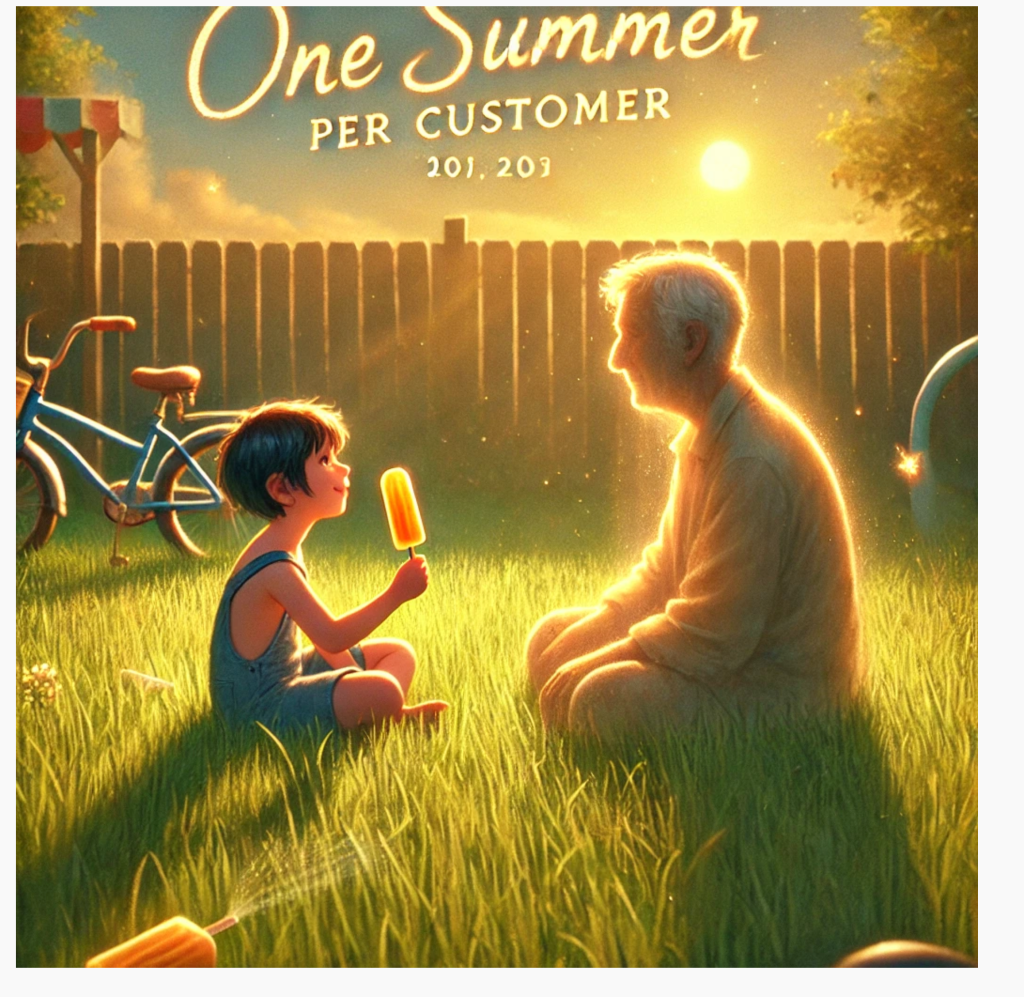
And there you are.
The child you used to be, sitting cross-legged in the middle of the driveway, Popsicle juice staining your chin, the bike tipped over on the lawn, its wheels still spinning. You watch yourself, and it takes a moment to reconcile that this was you: small, invincible, and utterly unaware of the weight that life would one day press upon your shoulders.
“Who are you?” the child asks, squinting at you through the golden haze of summer.
You open your mouth to explain, but the words feel heavy, unwieldy. How do you tell your younger self that you’re here from a world they can’t imagine? A world where summers are shorter, voices are quieter, and the people they love are slowly becoming photographs on a dusty shelf.
The driveway dissolves, and you find yourself in the old arcade. The smell of popcorn and quarters fills the air, and the sound of 8-bit music buzzes in your ears. Your grandfather stands at the claw machine, pretending to strategize but always letting you win the stuffed animal. Your parents sit in a corner booth, laughing over greasy pizza, still young, still alive.
You want to scream, Don’t leave! Don’t fade! But the words catch in your throat because you know this is how it works. This was their summer too, and they spent it the best they could. They didn’t know how few of them there would be.
And now, they’re gone. The arcade is gone. The laughter, the greasy pizza, the soft hum of their presence—it’s all gone. Except for now, for this moment, for this impossible glimpse into a time you’ll never touch again.
The scene shifts again. You’re standing in your grandparents’ backyard, the smell of charcoal and lilacs drifting through the air. Your grandmother is slicing watermelon at the picnic table, humming a song she’ll never sing again. Your grandfather is fiddling with the radio, trying to tune in a baseball game.
You feel the lump in your throat rise as you watch them, so alive, so blissfully unaware of how fragile it all is. You want to tell them. Tell them everything. How much you miss them. How you think about their voices every time you hear the word home.
But they can’t hear you. This is their summer, and like all summers, it’s fleeting. You want to stay, to bottle the sound of your grandmother’s laugh, the way your grandfather’s hands move when he tells a story. But the scene fades, as it must, because the past is greedy, and it never lets you linger.
You’re back in the driveway now, staring at the child you used to be. They’re looking at you with a mix of curiosity and suspicion.
“You’re me, aren’t you?” they ask.
You nod, the lump in your throat too big to speak around.
“What’s it like?” they ask. “Getting older?”
You want to lie. You want to tell them it’s magical, that everything works out, that the laughter never fades and the summers never grow shorter. But that would be cruel.
“It’s harder,” you say. “But it’s worth it. You’ll lose things you love—people, places—but you’ll also gain things you can’t imagine right now. You’ll love, you’ll hurt, you’ll create, and you’ll survive. And you’ll never stop missing this.”
They tilt their head, their curiosity unguarded, their world still infinite. “Why are you here?”
You pause, the words tangled in the back of your throat, heavy with the weight of all you’ve seen and all you wish you could protect them from. When you finally speak, your voice is careful, like stepping onto thin ice.
“To tell you something,” you say.
“What is it?”
You kneel down, your gaze locking with theirs—a version of yourself so bright, so free of the shadows that time inevitably casts. “You only get one life,” you say. “And it’s one summer per customer. So don’t waste it. Eat the Popsicles. Ride the bike. Hug them all a little tighter. This doesn’t last forever.”
The child looks at you for a moment, the gears of their young mind turning. Then, they smile. And in that smile, you see something remarkable: not full understanding, not yet, but a seed planted. A glimmer of what might one day bloom.
And just like that, the moment is gone.
You’re yanked back to the present, the golden haze of the past replaced by the sterile, fluorescent glare of your adult life. The backyard fades, the scent of cut grass and charcoal evaporating like a dream upon waking. Bills sit in their neat little pile. Deadlines loom like storm clouds. Your phone buzzes incessantly on the counter, demanding attention you no longer want to give.
But the past doesn’t fully let go. It lingers in the air around you, a faint echo of laughter, the distant hum of cicadas.
Then you hear it—a faint, childlike voice. “Eat the Popsicles. Ride the bike. Hug them all a little tighter.”
And you realize something. The child didn’t understand everything you said, but he understood enough. Enough to plant a seed. Enough to carry forward a tiny piece of wisdom, waiting to bloom when the time is right.
It’s not just the child you left behind. It’s the child that still lives within you, nestled in a hidden part of your mind, buried under layers of deadlines and regrets, waiting for someone to kneel down and remind them: You only get one life. And it’s one summer per customer.
It’s not just a rule of childhood. It’s the law of life itself. You can try to go home again. But there is only one summer per customer.This summer, this moment, this fleeting stretch of days—it’s the only one you’ll ever get. There will be others, but not this one. Not with the same people, the same chances, the same fleeting opportunity to grasp at something real before it slips away.
The rule is ironclad. No exceptions. In this lifetime, or the next. The last stop in the vast design of things.
Only one summer per customer.
 Chris Conidis is a versatile improv performer, filmmaker and writer, celebrated for his inventive blend of improv and comedy from Saint Cloud, Florida.