
Chris Conidis Writer Author Performer
Let’s take a moment to reflect on the peculiar species we call us. Picture this: humanity as a cosmic prototype, a Frankenstein fusion of primordial biology and emergent technology. We’re self-replicating wetware strapped into a sack of meat, armed with overclocked brains that nature cobbled together in its version of a garage lab. And here we are, orbiting around existential questions like “What is a person worth?” while the universe silently shrugs, probably regretting it ever hit “run simulation.”
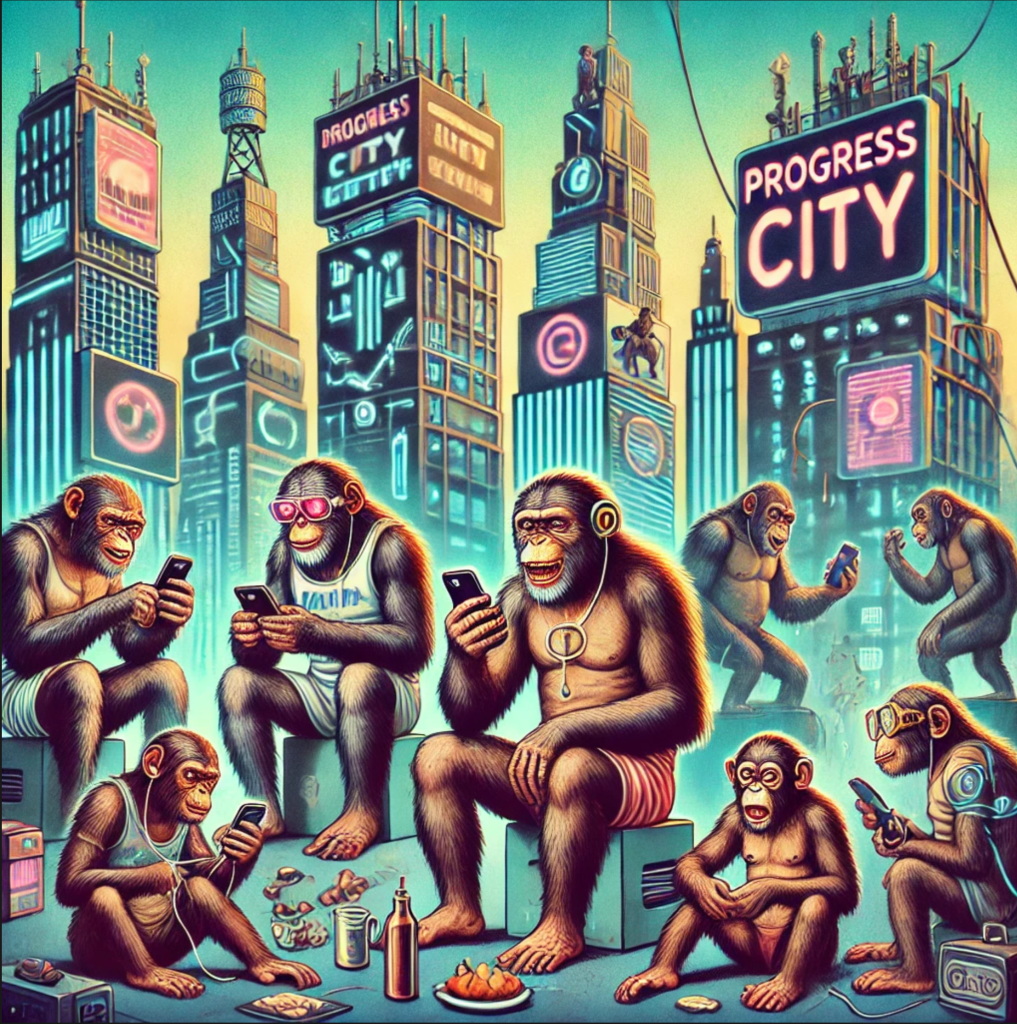
Consider the evolutionary journey: billions of years of blind trial and error led to the bipedal primates who thought it’d be a good idea to strap fire to sticks and call them rockets. We’re a paradox of progress—uplifted apes who conquered gravity but still argue over who left the seat up on the International Space Station. Our big, energy-sucking brains—neural engines running on 20 watts—are magnificent machines of imagination, capable of curing diseases, creating symphonies, and, on a slower day, inventing NFTs.
And yet, for all that brilliance, history reminds us of our expendability. During wartime, we’re meat-puppet soldiers sent to die on behalf of borders and ideologies. In times of peace, we’re currency in the economy of distraction, trading hours of life for glowing rectangles that sell us ads disguised as connection. Social media turns our lives into data streams, our thoughts into hashtags, and our self-worth into likes—a digital evolution of the pacifier.
Schindler faced the brutal arithmetic of valuing human lives in Schindler’s List, weighing his fortune against the souls he could save. But isn’t that the same calculus we quietly live under? Economists slap a dollar value on human life to justify insurance policies. Scientists estimate the energy required to replace us, as though humanity were an equation to be solved rather than a question to be pondered.
At our core, we’re nothing more than stardust—a recycled cocktail of cosmic leftovers forged in the belly of dying stars. Yet we’re also the universe looking back at itself, the only species (as far as we know) curious enough to ask, “Why?” Are we cosmic janitors cleaning up the mess of entropy? Or are we toddlers playing with matches, inventing tools to poke at the fabric of reality without knowing what we’re unraveling?
Our worth, then, isn’t in individual utility but in collective absurdity. We’re the accidental poets of the universe, improvising meaning where there may be none. The ascended apes who ask, “What does it all mean?” even as we binge-watch reality shows where people pretend to survive on deserted islands.
So, what is a person worth? Scientifically, about $160 in raw elements. Philosophically? Priceless and pointless, simultaneously. We’re paradoxes in pants, primates with delusions of grandeur, proof that evolution is both genius and comedian. The value of a human isn’t in the sum of their atoms but in the stories we tell, the questions we ask, and the memes we post when we should be sleeping.
And here’s the kicker: You, dear human, are a limited-edition model! Yes, that’s right, each of us is a bespoke mashup of DNA, shaped by billions of years of R&D (Randomness & Dumb luck). Think of yourself as the Swiss Army knife of biology—inefficient at almost everything but able to do a little bit of anything. You come with built-in features like opposable thumbs (great for texting complaints to customer service) and a prefrontal cortex (perfect for overthinking those complaints at 3 a.m.).
But wait, there’s more! Your brain—this marvelous, calorie-burning supercomputer—comes preloaded with existential dread, anxiety about the future, and the inexplicable urge to binge-watch shows about people baking cakes shaped like hamburgers. Sure, it’s prone to glitches, like believing conspiracy theories or forgetting why you walked into a room, but think of those as quirks, not bugs.
Are you worried about your expiration date? Don’t be! Humanity has devised a brilliant workaround: legacy. That’s right, you can upload your worth to the collective hive mind by reproducing, inventing something, or just going viral for falling off a trampoline. History books are full of these upgrades. Or, as social media proves, at least an endless scroll of people shouting, “Notice me!” into the void.
Feeling undervalued? Let’s talk upgrades! Why settle for “cosmic accident” when you can frame yourself as The Ultimate Cosmic Achievement™? Add a philosophical filter and voilà! You’re not just a person; you’re the heroic protagonist of your own universe. Every bad day? A plot twist. Every awkward moment? A character arc. Even your messy room? Evidence of a creative genius at work!
And if all this sounds like a sales pitch, well, that’s because it is. We’ve been selling ourselves—to gods, to bosses, to algorithms—for millennia. Religion, politics, and capitalism are just variations on the same theme: proving your worth to an invisible audience. In ancient times, we threw virgins into volcanoes to appease the gods; today, we throw selfies into Instagram to appease the algorithm. Progress!
So here’s to you, technological monkey, cosmic miracle, and walking contradiction. You are worth exactly as much as you believe—or as much as someone’s willing to pay. Life is short, absurd, and full of plot holes, but at least it comes with opposable thumbs and Wi-Fi. And in the grand scheme of things, that’s worth more than a handful of stardust, isn’t it?
 Chris Conidis is a versatile improv performer, filmmaker and writer, celebrated for his inventive blend of improv and comedy from Saint Cloud, Florida.